SupraNOS

Next-Generation
Network Operating System for AI
Built on SONiC. Designed for Open, Flexible,
and Scalable Networking

An AI-native network operating system engineered for enterprise networks, data centers, and AI infrastructure. It delivers high performance, scalability, and operational stability through an open networking architecture.

/Network Operation System

An open network operating system standing on the shoulders of SONiC

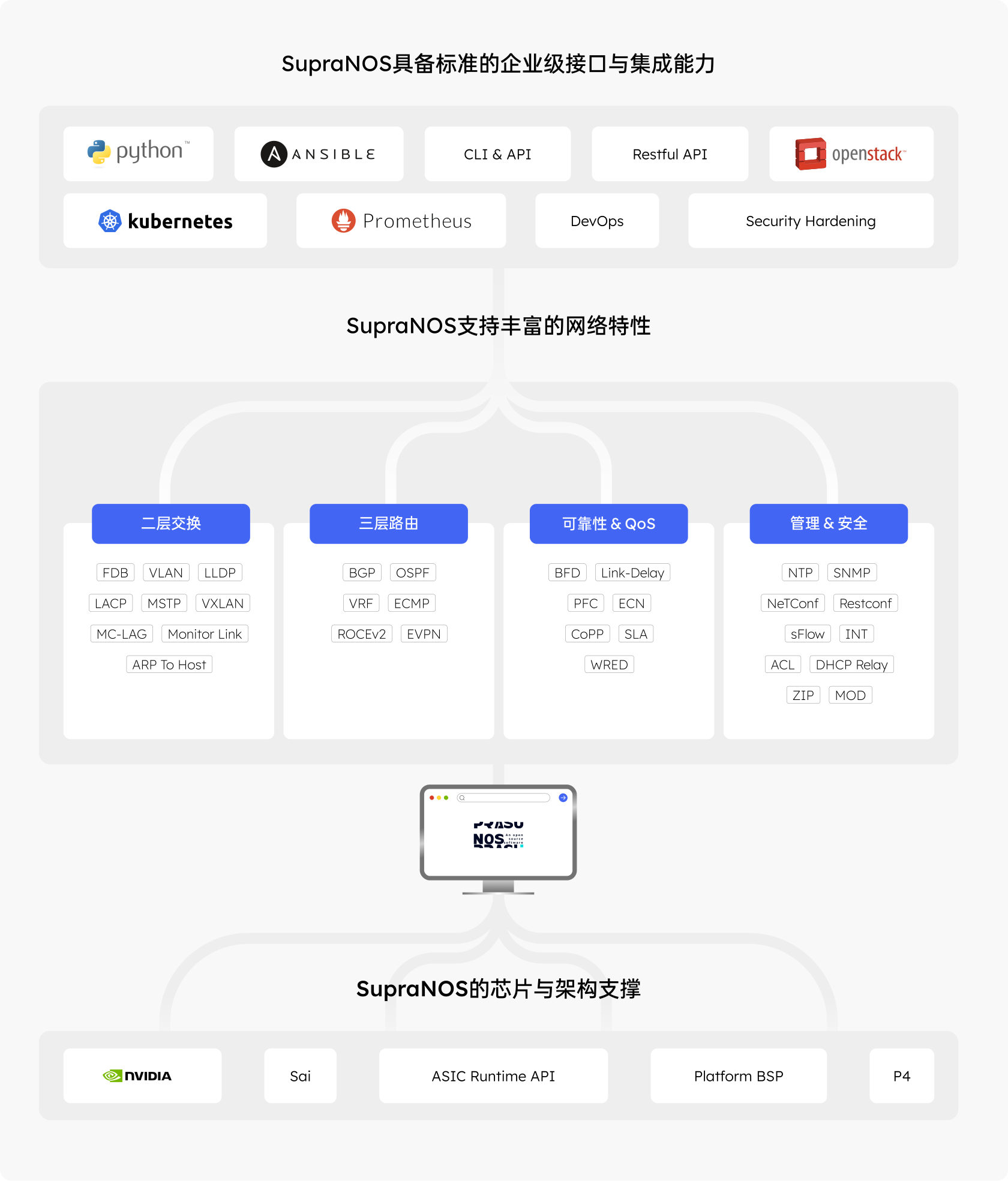
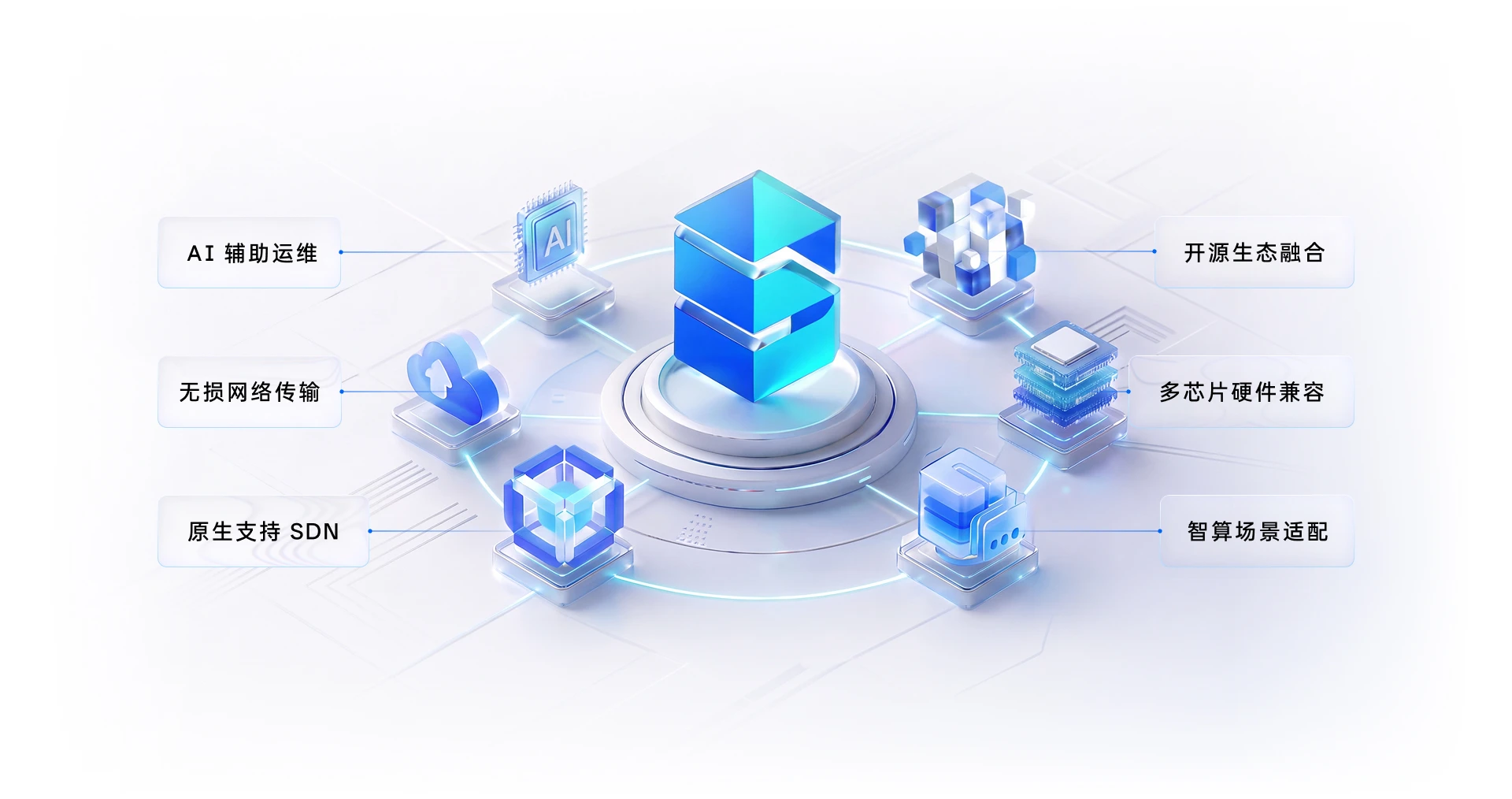
SupraNOS is a high-performance network operating system independently developed by Supranett based on the open architecture of SONiC. Designed for ultra-large-scale intelligent computing clusters, it is compatible with NVIDIA’s mainstream intelligent computing switch chip architecture. With software-hardware decoupling, component decoupling, and open capabilities as its core design principles, the platform delivers high-performance, highly scalable, stable, and easy-to-use open network solutions.

SupraNOS

/Joint explore compute network

Industry-Academia-Research Joint Exploration of Computing Power Network

Collaborative Innovation

Supranett and Zhejiang University Shanghai Advanced Research Institute have jointly established the "Algorithm Optimization Joint Innovation Laboratory," focusing on collaborative research in areas such as in-depth development of the SONiC system, AI cluster network optimization, containerized architecture, and software-hardware ecosystem adaptation. Together, they aim to develop SupraNOS, a high-performance network operating system tailored for data centers and cloud environments, driving core technological innovation and the transformation of achievements.

Computing Power Optimization Joint Innovation Laboratory

Redis Data Layer Enhancement and Multi-Instance Architecture

Compatible with the SONiC Redis single-source data model, it introduces namespace-based multi-instance deployment to horizontally scale the control plane ASIC; it also optimizes batch pipeline reads, reducing interaction overhead and overcoming the performance bottleneck of large table reads.

Hot Patching and Patch Management Capability

Support patch building, management, and on-demand hot update distribution, and improve the configuration patch management system; shorten the response cycle for on-site fault repair and reduce reliance on full device version upgrades.

ARP / Neighbor Learning Optimization

Introduce active probing for high-frequency ARP/ND interactions in intelligent computing, and finely tune neighbor entry aging and protection parameters; strengthen the control plane to enhance forwarding stability in ARP storm and silent host scenarios.

Command line system greatly expanded

Compatible with native SONiC CLI, added coverage of hundreds of commands across multiple domains such as BGP, interfaces, AAA, ACL, BFD, and AI services; supplemented with multiple practical O&M commands, providing an operation experience that is close to traditional devices with complete coverage.

/key Technology enhancement

SupraNOS
Key Technology Enhancement

Deep optimization

/Key Features

Three Pillars of Features
Decoupling, Lossless, Easy to Use

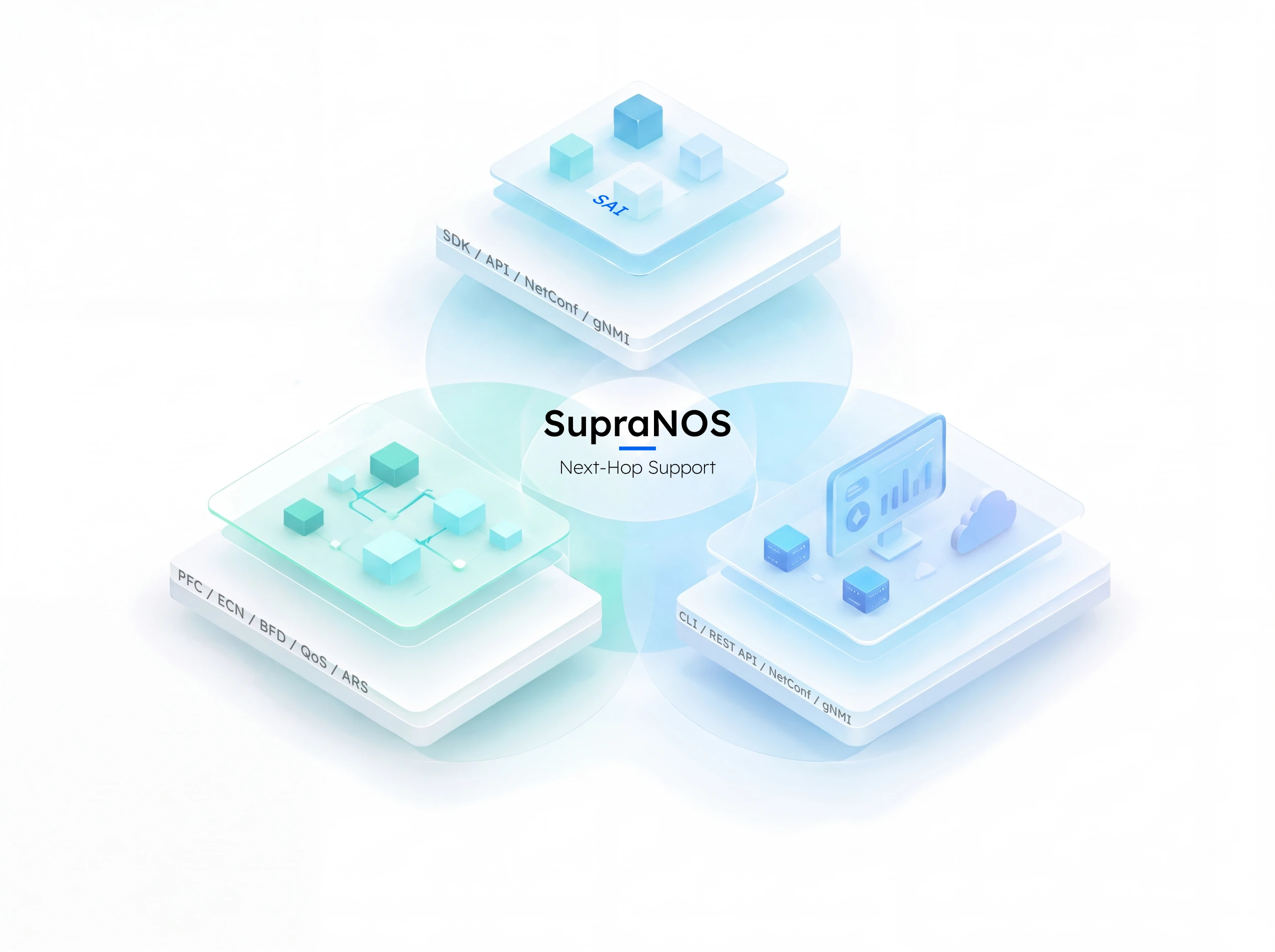
SupraNOS Next-hop Support

01

software-hardware decoupling

Implementing software with SAI as the standard interface
and decoupling from chip architecture

SupraNOS uses SAI (Switch Abstraction Interface) as the hardware abstraction boundary, decoupling upper-layer network functions from the underlying chip implementation. This ensures independence between network software and hardware, enabling smooth evolution and reuse of software capabilities. There is no need to restructure the operating system or retrain operational skills for new chips, significantly reducing the total cost of ownership.

02

Lossless Bearing

For RDMA intelligent computing traffic
building an end-to-end base

Congestion Management

PFC per-hop backpressure prevents packet loss, combined with ECN endpoint rate reduction, building an end-to-end congestion closed loop.

Reliability assurance

BFD fast fault detection + link-delay awareness, achieving second-level fault failover.

QoS system

Through CoPP, WRED, and SLA metrics, provide refined protection for critical business traffic.

Adaptive Routing

Smart Computing ARS Adaptive Routing balances large model communication traffic and improves overall network throughput.

03

Ease of Use and Openness

Network Device Class CLI + Native SDN
+ AI-assisted O&M

Seamless migration of operational habits

A CLI resembling traditional devices, bypassing the learning curve of Linux commands, reducing deployment costs, and offering a fully expanded command set capability.

All Abilities Fully Unlocked

Supports northbound interfaces such as REST API, NetConf, and gNMI, and is compatible with K8s, SDN, and mainstream monitoring tools.

Intelligent Operations and Maintenance

Integrate AIOps with sFlow/INT telemetry, achieve automatic fault location, and evolve toward self-healing operations.

/Key Features

Open and Converged Network Architecture

system architecture
开放融合的网络体系
SUPRANETT

Let's chat about solutions?

Chaohuilian focuses on AI hyperscale cluster infrastructure, maximizing the value of each GPU.